
How to Find the Right IIT Coaching Center in Hyderabad?
For students who want to succeed in the IIT-JEE exam, choosing the right coaching institute may be the biggest decision they will have to make during their education. There are...
Empowering learners and educators with a comprehensive platform that bridges the gap between traditional and modern education. iStudy inspires excellence in education and fosters growth for a brighter future.



The National Eligibility and Entrance Test or NEET 2026 will be a major opportunity for aspiring doctors to earn an MBBS, BDS or other medical degree in India against many more candidates than available seats. To be successful at the NEET exam candidates need to demonstrate a good deal of knowledge and have a systematic plan for how to study. Vignan Junior Colleges can help students prepare for NEET through a combination of concept clarity, practice of exam questions under time pressure and managing their study time efficiently.
The following are tips from faculty experts on how applicants to the NEET 2026 should prepare for the exam to be more likely to succeed.
A successful NEET preparation begins with a clear understanding of the exam pattern and syllabus. NEET 2026 consists of:
50% of questions in Biology provide a significant amount of weight toward students' assessment results. Physics & chemistry each have half as many questions contributing towards assessment results. Knowing the heaviest-load chapters for each of these subject areas will allow students to allocate their study time more efficiently during evaluation / testing preparation.
Discover expert-recommended strategies for Biology, Physics, and Chemistry to maximize your NEET 2026 score efficiently.
Biology is considered one of the best scoring subjects in NEET exam colours any half of the total no of questions. Experts from each subject do recommend that students use only NCERT books to study as most of the questions will come directly from there. Each student should have a complete understanding of the diagrams, definitions, and processes related to Human Physiology, Genetics, and Ecology. Continuously practicing old year questions and mock tests will help with understanding how these types of questions are structured and how to remember them. Repetition is crucial because Biology is based on memory; therefore, if a student knows how to recall from with total accuracy under conditions of time pressure.
Physics necessitates equal parts idea clarity and rate of solution. The experts recommend that students first master key formulas, developments and concepts in high weight chapters like Mechanics, Electrostatics and Modern Physics. To become fast and accurate with calculations, an individual should spend time practicing numerically each day. When students practice solving numerically (as it relates) in real-time exam conditions, this will help them develop their level of efficiency and their time management skills for future testing. Non-content based problem solving will give students the confidence in their ability to respond to problems that are based on applications.
For NEET, chemistry will include 3 parts; Physical, Organic and Inorganic Chemistry. Each part should be approached differently. For Physical Chemistry your strategy will be to perform math problems every day; pay close attention to your formulas; and learn the concepts. Organic Chemistry requires you to be familiar with reaction mechanisms, named reactions, and functional groups and how they transform. Lastly, Inorganic Chemistry will require you to memorise compounds, trends in the periodic table and properties. Making concise notes will help greatly with this area of chemistry. Experts recommend regularly revising the high-yield areas and also keeping a short formula sheet for last-minute revision.
The faculty emphasizes how important it is to allocate time properly to obtain the highest possible scores. A student should have a balanced schedule for the day in the following way: approximately 40% of time devoted to studying Biology, 30% of time studying Physics, and 30% to studying Chemistry. Students should revise their studies every day throughout the week for new material and should take at least 1-2 full-length mock tests per week to determine strengths and weaknesses. Short, concentrated studying with scheduled breaks will help to prevent burnout.
Practicing previous years’ papers and simulated tests is the cornerstone of NEET preparation. Faculty insights include:
Mock tests also help students develop exam temperament, reducing anxiety on the actual NEET day.
Revision is crucial in the final months before the exam. Experienced faculty recommend:
NEET 2026 will test both knowledge and composure. Faculty advise:
Successful preparation for NEET 2026 takes more than working hard; it requires working smart, applying effort to keep moving forward regularly, following your strategy, and applying discipline. By following an experienced instructor’s advice, being disciplined in your study habits, and consistently practicing, you can increase your chance of success on exam day.
At Vignan Junior Colleges, we will guide you through each step of the process so that you have the tools, knowledge, and resources needed to realize your goal of attending a top medical university. With our strategic approach, determination, and smart revision methods, NEET 2026 success is attainable!
1. How many hours should I study daily for NEET 2026?
6–8 focused hours, balancing Biology, Physics, and Chemistry with regular revisions.
2. How can I improve my percentile?
Focus on accuracy, solve mocks, revise high-yield topics, and analyze mistakes.
3. Is time management important during the exam?
Yes, attempt easy questions first and maintain speed and accuracy throughout.
4. How does Vignan Junior Colleges help?
Expert faculty guidance, mock tests, personalized mentoring, and subject-wise strategy to maximize scores.
For students who want to succeed in the IIT-JEE exam, choosing the right coaching institute may be the biggest decision they will have to make during their education. There are...

Selecting an appropriate college to attend after the completion of their secondary education is vital for an individual who wishes to prepare for a highly competitive examination such as JEE...

Stepping into intermediate education is a crucial phase in every student’s academic journey. It is a time when the foundation for future careers is built, and making the right choices...

To crack JEE requires the right support, regular practice and a solid academic background. This is why almost all aspirants are searching for best IIT coaching centers in Hyderabad which...
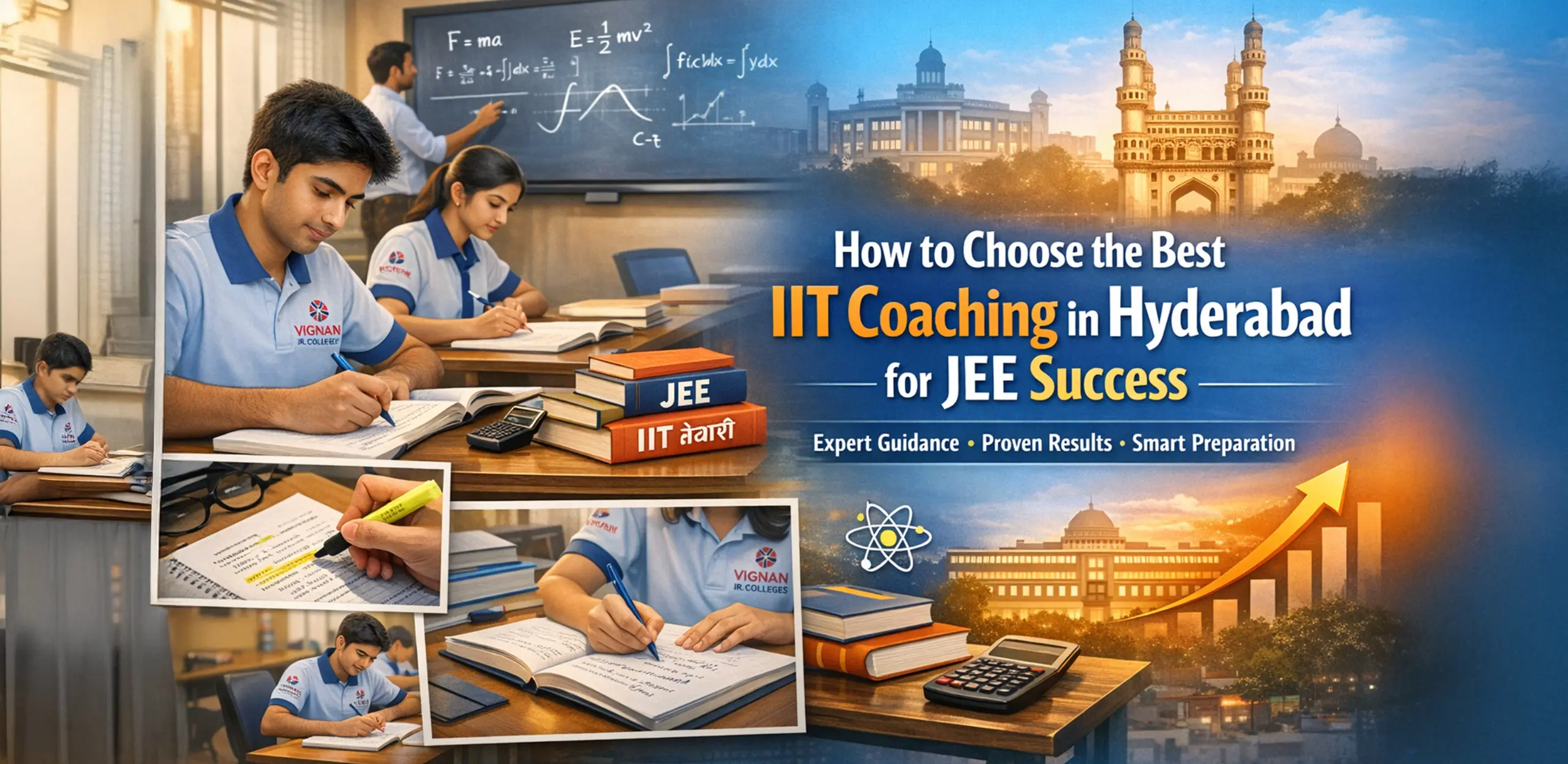
When it comes to choosing an institution to receive coaching as a JEE aspirant, the selection of the appropriate coaching institution is very important. Since there are so many students...
Comments